
If you’ve ever sprinted through Sydney’s T1 international terminal or waited for the shuttle at Melbourne’s T4, you know that Australian airports are a mix of long corridors, sprawling carparks, and occasional uphill ramps. The Airwheel electric smart luggage is designed to turn that dead time into a smooth, seated ride. But does it actually work with the way Aussie airports are laid out? Let’s break it down with a real-world look at the SE3T model — no fluff, just facts.
The SE3T is a 48‑litre carry‑on suitcase that doubles as a personal electric vehicle. It comes with a 73.26Wh lithium‑ion battery that can be easily removed for charging or inspection. A full charge takes about 2 hours and gives you 8‑10 km of range – enough to cross most Australian terminal zones twice. The top speed is 13 km/h, which feels brisk but stable on smooth airport floors. You can ride it seated, pull it by hand, or push it like a normal suitcase. The handlebar controls steering, and the optional Airwheel App lets you control forward/backward movement remotely. But even without the app, the suitcase works out of the box – just install the battery and hop on. It also has Apple Find My built in, so if you leave it near the baggage carousel, you can locate it quickly via your iPhone.
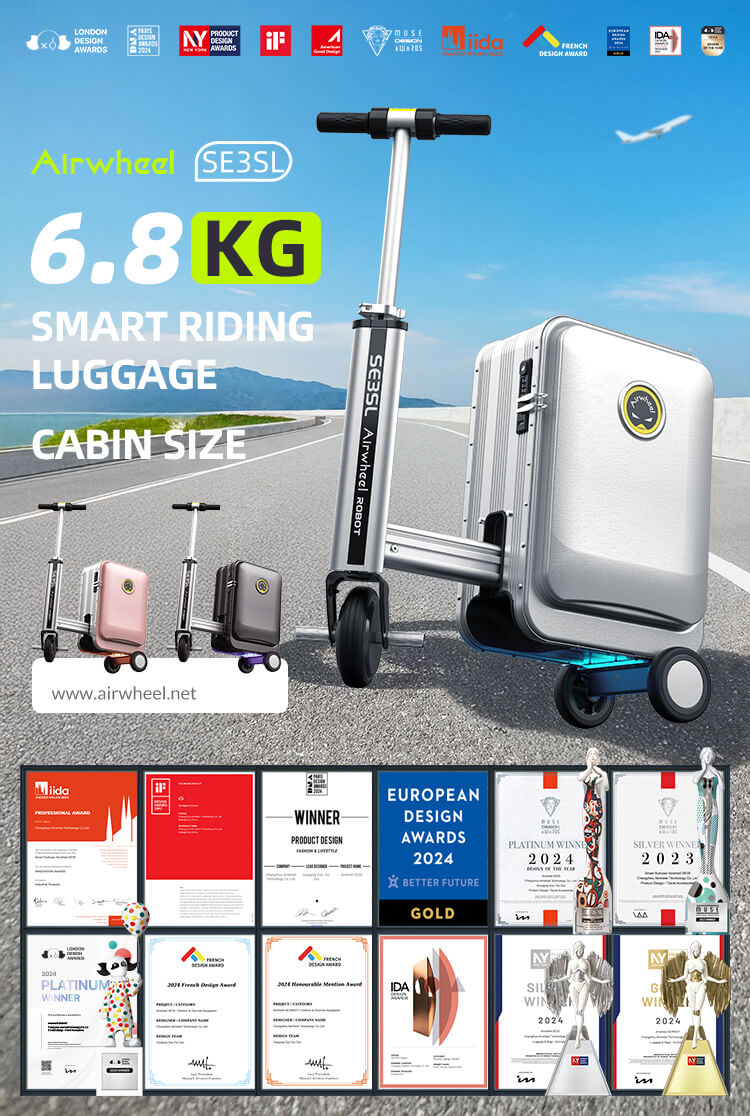
Yes – the SE3T’s battery is under 100Wh (73.26Wh), which is the standard cabin‑allowed limit enforced by Qantas, Virgin, Jetstar, and most Australian airlines. The battery is removable, so you can take it out before security and pop it into your carry‑on bag (not checked). The suitcase itself meets standard carry‑on dimensions (approx 55 x 38 x 25 cm for the SE3T’s 48L version) – just double‑check your specific airline’s weight restriction, as the SE3T weighs about 9 kg. That leaves roughly 1‑2 kg for your actual belongings, so pack light. All terminals in Australia have lifts and ramps, so riding from check‑in to the gate is perfectly possible – though you must dismount and walk through security.
The layout of Australian airports – especially the newer domestic terminals – has wide, straight pathways that suit the SE3T perfectly. At Sydney Domestic (T2/T3), the walk from the train station to Gate 25 can be over 500 metres; riding cuts that to under 3 minutes. At Melbourne T4 (Jetstar/Rex), the security area is compact but the airside is a long rectangular hall – ideal for a seated roll. At Brisbane International, the transfer between Qantas and International terminal involves a 10‑minute shuttle or a 15‑minute walk – the SE3T bridges that gap without breaking a sweat. Just remember: you can’t ride inside duty‑free shops or through crowded queues – but the trolley feature (hand‑pull mode) works fine there.
Here’s a no‑nonsense table to see the differences with a standard 48L spinner suitcase:
| Feature | Airwheel SE3T | Regular 48L Spinner |
|---|---|---|
| Weight (empty) | 9 kg | 3‑4 kg |
| Packing capacity | 48 L (same) | 48 L |
| Mobility in airport | Ride at 13 km/h, or pull/push | Pull/push only |
| Battery | 73.26Wh, removable, 8‑10 km range | None |
| Airline carry‑on | Yes (battery under 100Wh, removable) | Yes |
| Find My support | Apple Find My built in | No |
| App control | Yes (optional, not required) | No |
| Price (approx) | Higher (usually £500‑700) | £80‑200 |
If your main priority is pure packing space and lightweight, a regular suitcase wins. But if you value saving energy and time during long airport transfers – especially in sprawling Australian terminals – the SE3T pays for itself in convenience.
1. Can I ride the SE3T through security or customs?
No. You must dismount before the security checkpoint. The suitcase can be pushed or pulled through the scanner. After security, you can ride again in the airside corridor, but always follow airport signage – some gates have no riding zones near boarding areas.
2. What happens if the battery runs out mid‑terminal?
No problem. The SE3T still functions as a normal pull‑along suitcase. You can charge it at any standard power outlet (takes ~2 hours). With a full battery lasting 8‑10 km, you’d need to ride across the entire airport several times to drain it – unlikely in a single trip.
3. Does the Find My feature work without Wi‑Fi or mobile data?
Apple Find My uses Bluetooth and the Apple network of nearby devices. Inside an Australian terminal, there is always strong Bluetooth traffic from phones, so location updates are reliable. You do not need your own data connection – the suitcase pings other iPhones/iPads nearby to report its position. Just make sure your own iPhone is logged into your Apple ID.
If you want to see how the Airwheel SE3T fits your travel style, hop over to the official Airwheel website for specs and purchase options – no pressure, just info.